By late August the fruit stalls in Italy change character. Peaches move aside, and shallow wooden crates appear, heaped with figs so ripe they threaten to split before you get them home. For a few weeks the market smells sweet and slightly wild. Then, just as quickly, the best of it is gone.
Figs are not a fruit you buy by habit. A tray of pale Dottato and a tray of dark Brogiotto Nero behave nothing alike in the kitchen, and knowing which is which saves you from a jam that never sets or a crostata that turns to soup. What follows is a working guide to the varieties you are most likely to meet between late summer and autumn, and what each one is actually good for.
Fioroni, Forniti, and Why One Tree Tastes Different Twice
Before varieties, the harvest. Many Italian figs are bifere, meaning they fruit twice. The first crop, the fioroni (or simply fiorone), arrives in June and early July on last year's wood. These figs are large, pale and mild, with a looser, more watery flesh. They are pleasant, but they are not the reason anyone waits for September.
The second crop, the forniti, comes from August onward on new growth. Smaller, heavier for their size, denser and markedly sweeter. In the south you will hear them called settembrini, the September figs. When a recipe, a market seller or a neighbour says "the figs are ready", this is the crop they mean. If you are buying for baking or preserving, ask specifically for forniti — the difference in sugar and texture is not subtle.
Not every fig is bifera; some varieties give one generous crop instead. But across most of Italy, the pattern holds: an early, showy, gentle fig, then a later, darker, more concentrated one.
The Pale Ones: Dottato, Paradiso, San Pietro
Dottato
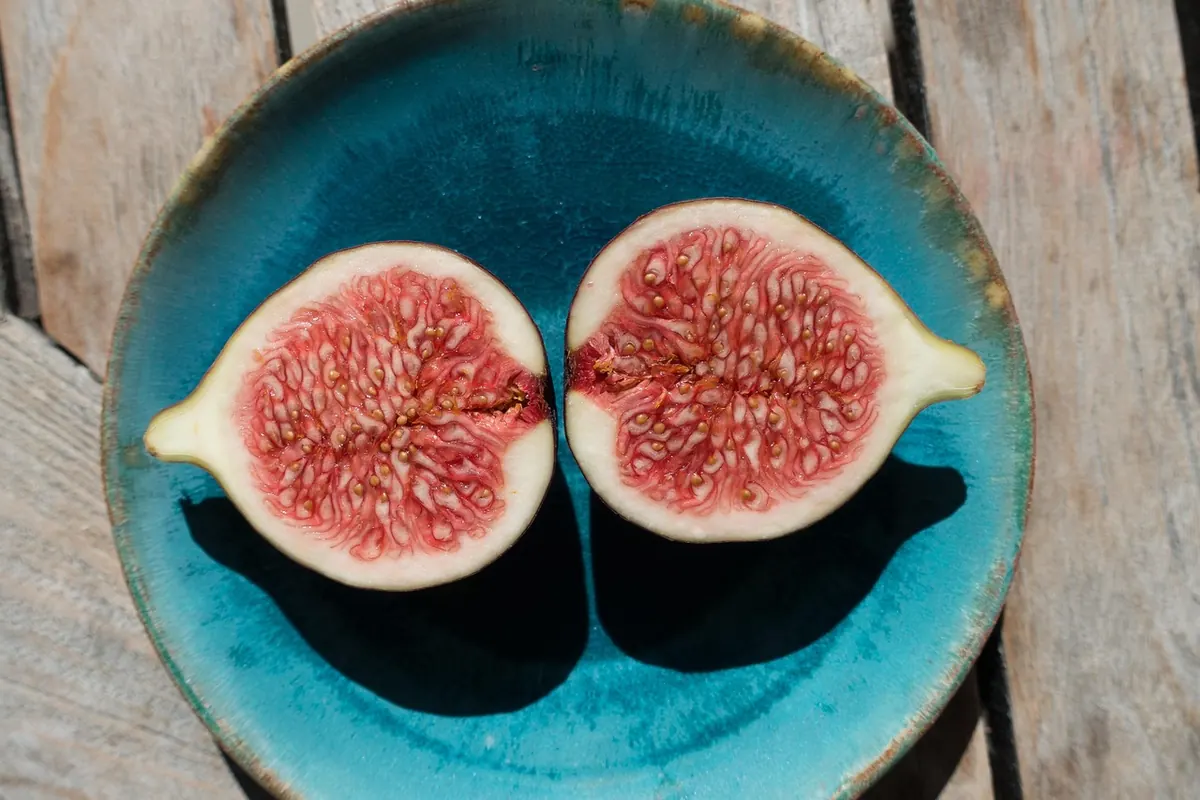
The most planted white fig in the south, and the backbone of Italy's dried fig trade. Look for a pale green-yellow skin that often blushes at the neck, a thin skin that marks if you handle it roughly, and an amber, honey-coloured interior with fine seeds. The flavour is gentle — honey, a little almond, almost no acidity. It is the fig behind the protected dried figs of Cosenza and the Cilento, and in Tuscany it is the base of the Carmignano fig tradition, where the fruit is dried and strung.
Eat Dottato fresh, ideally slightly chilled then brought back to room temperature, or split it and lay it over ricotta. It dries beautifully because of its low acid and high sugar. For baking, use it where the fig is the topping rather than the structure — halved on a crostata, tucked into focaccia — since its thin skin collapses quickly in a hot oven.
Paradiso and San Pietro
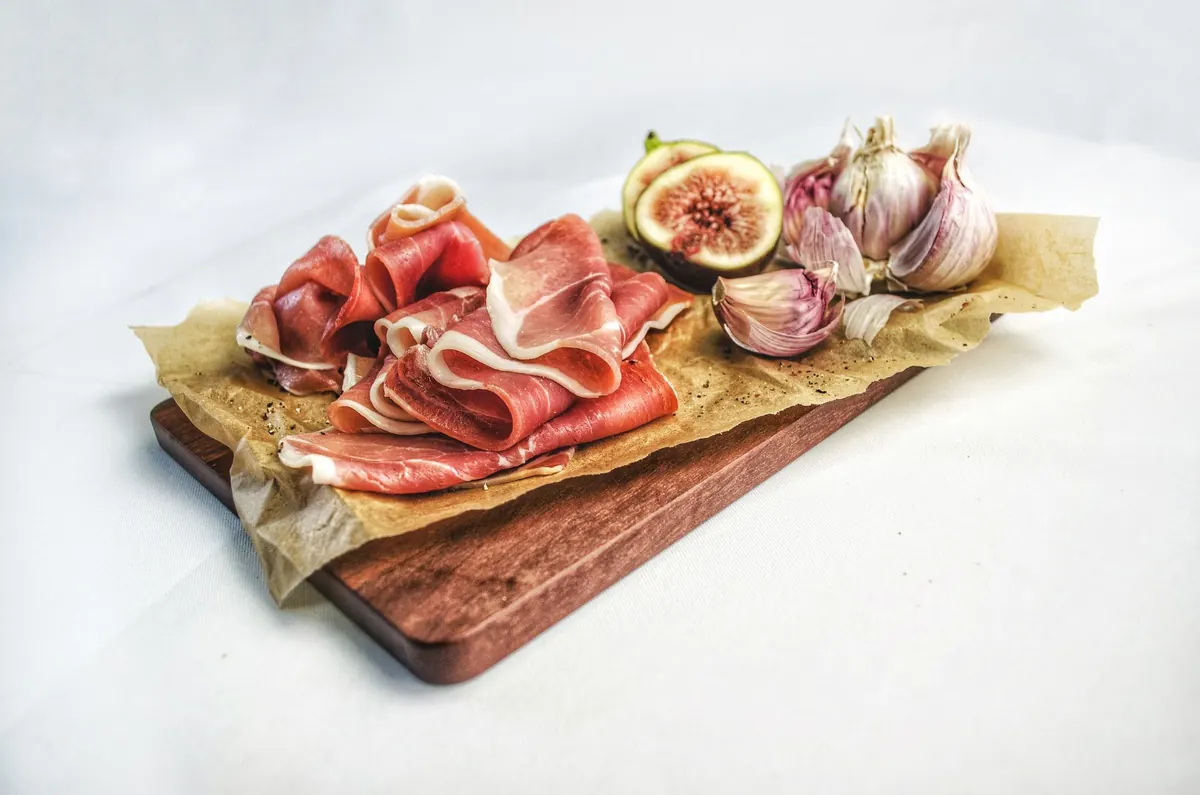
Both are big, pale, generous figs, common in Lazio and Campania, often sold as "fichi bianchi" without further ceremony. The flesh is juicy and mild, the skin delicate to the point of fragility. They are made for eating out of hand, over ice cream, or with a slice of prosciutto crudo, whose salt flatters their sweetness. Do not plan a jam around them. Low acid and high water make a jam that tastes flat and refuses to thicken without a great deal of sugar and lemon.
The Dark Ones: Brogiotto Nero, Melanzana, and the Green-Red Types
Brogiotto Nero
Deep violet-black outside, crimson and jammy within, with a flavour closer to berry compote than to honey. This is the variety to reach for when the figs are destined for the pan. It holds its shape long enough to roast, gives up its juice without turning to mush, and produces a jam with real depth. Try it halved, roasted with thyme and a little honey, then spooned alongside aged pecorino or a piece of roast pork.
Melanzana
From Puglia, as the name suggests: elongated, aubergine-purple, with a deep red, sweet interior. Slightly firmer than the pale figs, which makes it a good all-purpose choice — good fresh, good baked, good sliced into a salad with bitter greens and a sharp dressing.
Verdino and similar green-skinned figs
In the Po valley and the north you will find green figs with pink-red pulp, among them Verdino and Verdesca. They are sweet but carry a small, welcome flicker of acidity. That acidity is exactly what a jam needs, and it also makes these figs the best of the green group for pairing with fatty meat — duck, pork, game birds — where a purely honeyed fig can taste cloying.
How to Choose Figs at the Market
Ripeness in figs cannot be judged by colour alone; a dark fig can be hard and a green one perfectly ready. Use your hands and nose.
- The neck. A ripe fig bends at the stem. If the stem stands up stiff and straight, it was picked early.
- The eye. A bead of syrup at the base is a good sign. A split, weeping eye means it will not last the day.
- The feel. Heavy for its size, with a soft give like a ripe peach. Squashy, damp or wrinkled at the stem end is past its best.
- The skin. Intact, slightly dull with natural bloom. Glossy and tight usually means underripe; torn skin means bruising.
- The stem end. Milky white latex is a clear sign of an immature fig. It will never ripen properly at home.
- The smell. Sweet and faintly floral. A sour or fermented note means the fruit is already turning.
Ask which are forniti, ask where they were grown, and ask to taste one. A good seller will hand one over without being asked twice.
Matching the Variety to the Job
A rough rule: pale figs for eating and drying, dark figs for cooking and preserving, green-acid figs for anything that needs balance.
- Straight from the hand: Paradiso, San Pietro, Dottato.
- With cured meat and cheese: Dottato with prosciutto; Brogiotto Nero with pecorino and honey.
- Roasting and baking: Brogiotto Nero, Melanzana, Verdino.
- Jam and preserves: Brogiotto Nero or Verdino, with lemon juice and about 30–40% sugar by weight.
- Drying: Dottato, split and dried slowly, which is where its low acidity works in your favour.
Buying, Storing and Serving: The Practical Part
Buy figs in quantities you can eat in two or three days. They do not improve after picking; they only decline. Keep them in a single layer, stem up, on a plate — a piled-up bag crushes the bottom layer within hours. Refrigerate only if you must, and bring them back to room temperature before serving, because cold mutes the perfume. Do not wash them until the moment you eat them.
If you end up with figs that are ripe but not quite giving, don't throw them out. Halve them, set them cut side up in a dish, scatter with sugar and a strip of lemon zest, and bake at 180°C for about fifteen minutes until the juices run. They will not be perfect eaten raw, but with mascarpone or over yoghurt they are very good indeed.
Buy figs the way you buy tomatoes: by feel, by smell, and in small enough quantities that nothing goes to waste.
The season is short, and it shifts every year with the heat. Late August and September belong to the south; October is when the centre and north catch up, with late figs hanging on into November in sheltered gardens. Go early in the morning, buy a little more than you think you need, and eat the softest ones on the way home.
Photo: stux / Pixabay