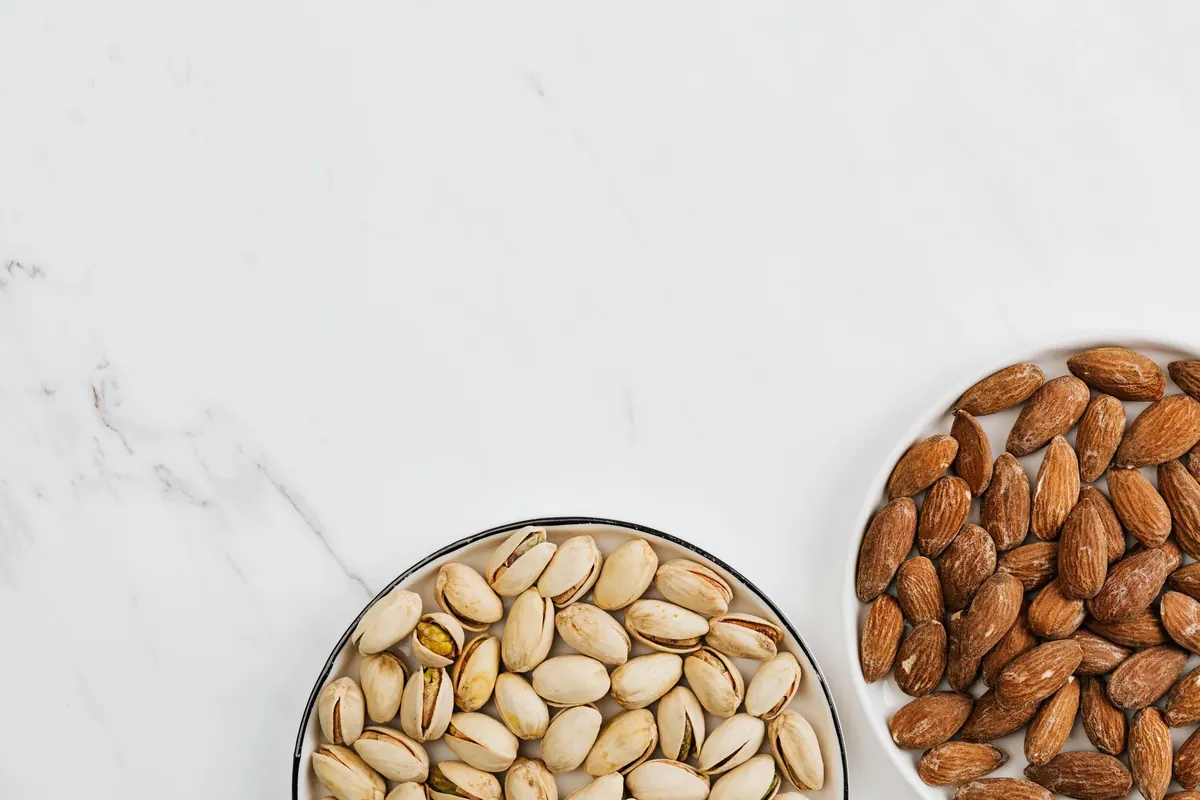
Walk through a market in Catania in late August and you will see them: small, tight, slightly dull shells, a green so deep it looks lit from the inside. Buy a bag of supermarket pistachios back home and you get something bigger, paler and easier to like. Both are Pistacia vera. Both are good. But they behave differently in a pan, in a pesto, and on a receipt.
This is a comparison, not a coronation. Sicilian pistachios — above all those from Bronte, on the western slopes of Etna — earn their reputation. The common pistachios sold in most shops are cheaper, more consistent and genuinely useful. Knowing which is which keeps you from overspending on a snack and underspending on a dessert.
Two Pistachios, Two Landscapes
Sicilian pistachio groves are not really orchards in the industrial sense. Around Bronte, the trees cling to terraces of dark volcanic soil, and the nuts are picked by hand in late summer, often in the coolest hours of the day. The local trees also alternate: a heavy crop one year, a light one the next. That rhythm alone makes the supply smaller and more expensive before anyone has roasted anything.
The Pistacchio Verde di Bronte carries DOP status, which sets rules on where the nuts are grown, how they are handled and how they are labelled. Smaller pockets of pistachio growing exist elsewhere on the island, but Bronte is the name most cooks know.
Most pistachios in the world come from very different places: the Central Valley of California, Iran, Turkey, and parts of the Mediterranean. These are large, irrigated orchards planted with selected varieties — Kerman is the well-known California one — harvested at scale and sorted by machine into tight size grades. The result is a nut designed for consistency. You can buy the same bag in three countries and get the same experience.
Flavor: Intensity Against Easy Nuttiness
Put a Sicilian pistachio and a common one side by side, unseasoned, and the difference shows up before you have finished chewing.
The Sicilian nut is sweeter and more aromatic. There is a grassy note, something faintly resinous or pine-like, and a long, clean finish that stays in the mouth. The texture is dense and oily rather than crunchy, and the flavour holds up when the nut is ground, churned or baked — which is why pastry chefs prize it.
Common pistachios taste milder and more straightforwardly nutty, with a buttery quality and, sometimes, a touch of bitterness from the papery skin. Roasted and salted, that profile is exactly right: moreish, easy, made for a bowl on a table. What it lacks is the aromatic lift that makes a pistachio cream taste of pistachio rather than of sugar and almonds.
A note on salt
Most widely sold pistachios are roasted and salted, which flattens subtle differences. If you want to compare properly, buy both unsalted and raw or lightly roasted, then taste them plain. It is a small experiment and a clarifying one.
Color and Size: What Your Eyes Can Tell You
Sicilian pistachios are small and slightly elongated, with a thin, pale shell that often splits only narrowly — and some nuts stay closed entirely. That is normal for these varieties, not a fault. Do not judge them by the wide, grinning split of a supermarket pistachio, which is a feature of other varieties and of mechanical sizing.
Under the shell, the kernel is a deep emerald green, sometimes shading to jade, wrapped in a violet-brown skin. Common pistachios are noticeably larger and their kernels run yellow-green to olive, with a similar purple skin but less vivid contrast.
That colour is a useful buying signal. Pistachio paste and gelato made from good Sicilian nuts look muted and khaki-green, not neon. If a spread glows like a highlighter, the colour is coming from the ingredient list, not the orchard. Historically, some imported nuts were even dyed red to hide blemishes — a reminder that pistachio colour has long been a marketing surface.
Why the Price Gap Exists
Sicilian pistachios cost substantially more, and the reasons are mostly agricultural rather than romantic. Hand harvesting is slow. Yields per hectare are modest. The alternate-bearing cycle halves the crop every other year. Add sorting, certification and the simple fact that demand from pastry makers exceeds what the slopes of Etna can produce, and you get a price that never feels like a bargain.
Common pistachios benefit from scale, irrigation, mechanisation and blended supply, and they are priced accordingly. Neither price is a trick. They are simply two different products with two different economics.
Best Uses in the Kitchen
The practical question is not which nut is better, but which nut belongs in which dish. A rough guide:
- Sicilian pistachios, raw or lightly toasted: pistachio pesto (with basil or mint, pecorino and good olive oil), where the nut should be the loudest voice.
- Sicilian pistachios, ground fine: gelato, semifreddo, cannoli fillings, torta and biscotti; also a crust for swordfish or lamb, pressed on with a little breadcrumb.
- Sicilian pistachios, chopped: a finishing touch on pasta, roasted vegetables or a plate of ricotta, where a small handful does real work.
- Common pistachios, roasted and salted: snacking, aperitivo bowls, chopped over salads where crunch matters more than aroma.
- Common pistachios, in quantity: granola, stuffings, bulk baking, homemade nut butters and anything that calls for 300 g and a moderate budget.
- Either, with care: pistachio cream spreads, where quality varies wildly. Read the label first.
How to Buy Well
A few habits will save you money and disappointment.
- Look for the full name. For Sicilian nuts, "Pistacchio Verde di Bronte DOP" on the pack is the signal; a vague "Sicilian-style" or a tricolour flag alone tells you little.
- Buy unsalted for cooking. Salt is easy to add and impossible to remove. Salted nuts are for eating out of hand.
- Smell before you commit. Fresh pistachios smell sweet and faintly green. A paint-like or old-oil smell means rancidity, and no amount of toasting will fix it.
- Read spread labels closely. Pistachio creams often list sugar first, followed by milk powder and a vegetable fat, with a modest percentage of pistachio. If the nut should be the point, buy paste with a high pistachio percentage or grind your own.
- Store them cold. Pistachios are high in oil. Keep them in an airtight container away from light, and freeze larger quantities for up to a year; they thaw in minutes and taste fresher for it.
One sensible note on health: pistachios are calorie-dense and the salted kind adds sodium, so if you are following a restricted diet, take advice from a doctor or dietitian rather than from a shopping guide.
The Short Version
Keep both in the cupboard and use them for different jobs. Buy Sicilian pistachios when the nut is the headline — a pesto, a custard, a cream, a dessert you want people to remember — and buy them unsalted, in smaller quantities, from a shop that turns its stock over. Buy common pistachios for snacking, for big batches and for anything where they play a supporting role. Neither choice is a compromise. It is just a matter of knowing what you are paying for, and letting the dish decide.